

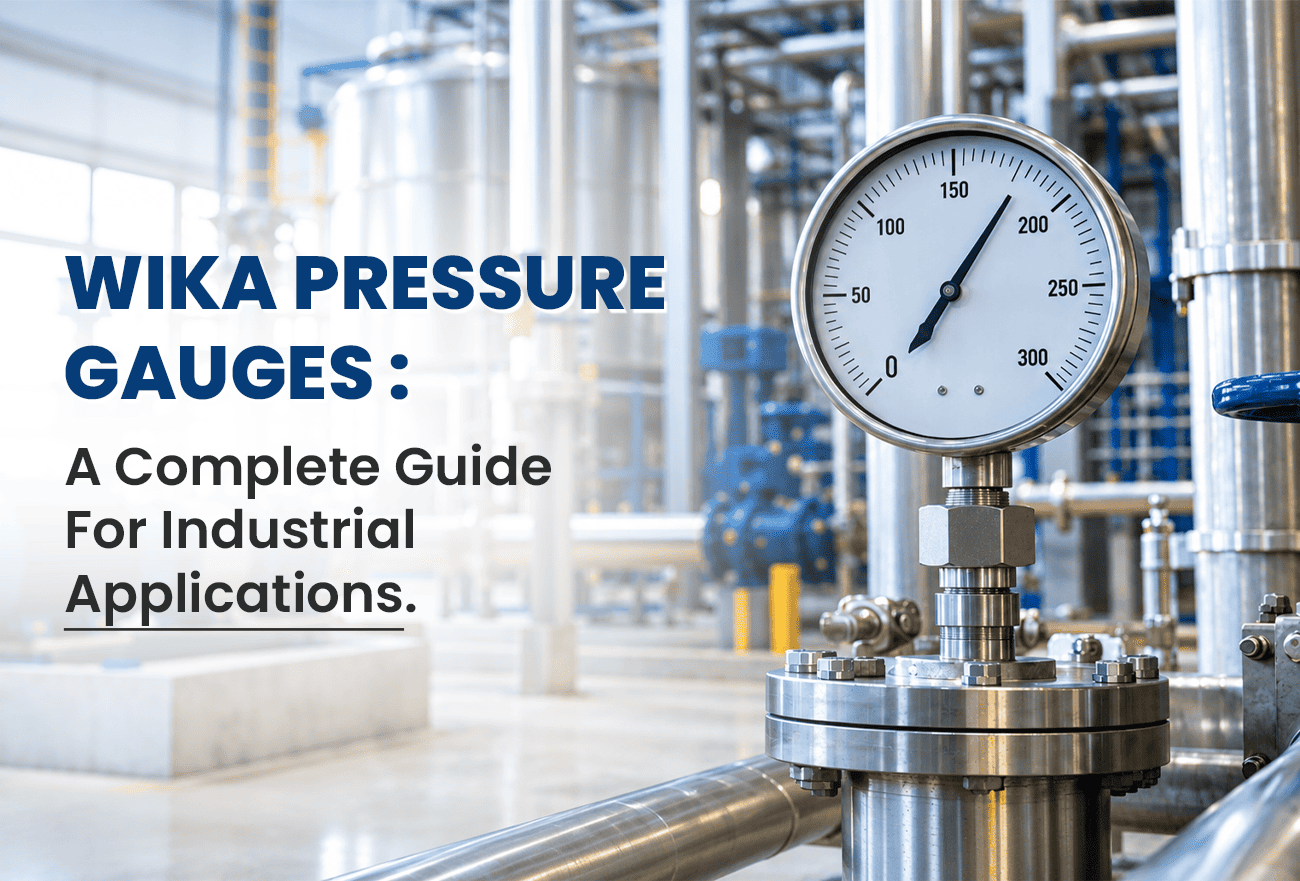
Pressure measurement is a small part of many industrial processes, but getting it wrong can create much bigger problems.
A pressure gauge helps operators know what is happening inside a pipe, vessel, pump, compressor, or process system. If pressure rises unexpectedly, falls below the required level, or fluctuates continuously, the gauge provides an immediate visual indication that something needs attention.
Among the widely used industrial measurement brands, WIKA pressure gauges are known for their range of mechanical pressure measurement solutions for different applications and operating conditions.
This guide explains the basics of WIKA pressure gauges, their common types, applications, selection factors, and maintenance requirements.
What Is a WIKA Pressure Gauge?
A pressure gauge is a mechanical instrument used to measure and display the pressure of a gas or liquid within a system.
WIKA manufactures a broad range of pressure measuring instruments, including mechanical pressure gauges designed for applications across industries such as manufacturing, oil and gas, chemical processing, pharmaceuticals, food and beverage, water treatment, HVAC, and energy.
Depending on the model and application, a WIKA pressure gauge can be designed for different pressure ranges, process connections, materials, temperatures, and environmental conditions.
For example, a basic gauge may be suitable for general machine applications, while a more specialized gauge may be required where there is strong vibration, aggressive media, high temperature, or strict hygiene requirements.
How Does an Industrial Pressure Gauge Work?
Most mechanical pressure gauges convert pressure into mechanical movement that is displayed on a dial.
One common design uses a Bourdon tube. When pressure enters the tube, it causes the curved tube to deform slightly. This movement is transferred through a mechanical mechanism to the pointer on the gauge.
The pointer then moves across the graduated dial to indicate the pressure.
The principle is relatively simple, but the construction and materials of the gauge determine where it can safely and accurately be used.
For instance, a gauge installed on a vibrating production machine may require a different design from one installed on a stable laboratory system.
Common Types of WIKA Pressure Gauges
WIKA offers different pressure gauge designs to suit different industrial requirements. Understanding the application is more important than choosing a gauge based only on its appearance or price.
- Bourdon Tube Pressure Gauges
Bourdon tube gauges are widely used for general industrial pressure measurement.
They can be used for measuring the pressure of gases and liquids when the process conditions are compatible with the gauge materials and design.
Typical applications include:
- Manufacturing equipment
- Pumps and compressors
- Hydraulic systems
- Pneumatic systems
- Process machinery
- General plant utilities
- Diaphragm Pressure Gauges
Diaphragm gauges use a flexible diaphragm instead of a Bourdon tube.
They can be useful for applications involving lower pressures, corrosive media, or media that may require separation from the internal measuring mechanism.
The exact suitability depends on the gauge design, materials, pressure range, and process conditions.
- Capsule Pressure Gauges
Capsule gauges are designed for relatively low-pressure applications and can be used for measuring certain gases.
They are often considered where a sensitive response is required at lower pressure levels.
- Differential Pressure Gauges
A differential pressure gauge measures the difference between two pressure points rather than pressure at a single point.
This can be useful for applications such as:
- Filter monitoring
- Flow measurement
- Level measurement
- Pump monitoring
- HVAC systems
- Process control
For example, if a filter becomes blocked, the pressure difference across the filter may increase. Monitoring differential pressure can therefore help operators identify when maintenance may be required.
How to Choose the Right WIKA Pressure Gauge
This is where many purchasing decisions go wrong. A gauge should be selected according to the actual process rather than simply choosing the nearest available pressure range.
Consider these factors before buying.
- Pressure Range
Start with the normal operating pressure and the possible maximum pressure.
A gauge should not normally operate continuously at the very top of its scale. Selecting an appropriate range can help provide useful readability and avoid unnecessary stress on the measuring element.
- Type of Pressure
Determine whether you need to measure:
- Gauge pressure
- Absolute pressure
- Differential pressure
- Vacuum
- Compound pressure
These are not interchangeable measurements.
- Process Medium
What will the gauge be exposed to?
Water, compressed air, oil, steam, chemicals, gases, and other media can have very different requirements.
The materials of the wetted components must be compatible with the medium.
- Operating Temperature
Temperature can affect pressure measurement and the gauge itself.
Always consider both the process temperature and the surrounding ambient temperature when selecting an instrument.
- Vibration and Pulsation
A gauge installed on a vibrating machine or near a pulsating pump may require additional protection or a design suitable for those conditions.
For example, a gauge that works well on a stable compressed-air line may not be the right choice for a high-vibration pump installation.
Pressure Gauge Maintenance and Calibration
Pressure gauges should not simply be installed and forgotten.
Regular inspection can help identify problems such as:
- Pointer movement that appears abnormal
- Damaged dial or case
- Leakage around the connection
- Corrosion
- Zero-point deviation
- Unusual fluctuations
- Mechanical damage
The required inspection and calibration frequency depends on the application, operating conditions, accuracy requirements, and company procedures.
Calibration should be performed using suitable equipment and according to an established procedure.
For critical applications, maintaining calibration records can also help with quality management and traceability.
y become unreliable because of wear, damage, contamination, or process conditions.
WIKA Pressure Gauges: Choosing Based on the Application
There is no single pressure gauge that is ideal for every industrial process.
A manufacturing machine may need a straightforward mechanical gauge. A chemical process may require materials and construction appropriate for the process medium. A filter monitoring application may benefit from differential pressure measurement. A low-pressure gas application may require a different measuring element altogether.
The right approach is to begin with the process requirements and then identify the appropriate gauge specification.
For businesses purchasing industrial instrumentation, it is also useful to review the manufacturer’s technical documentation and product specifications before final selection.
Final Thoughts
WIKA pressure gauges can be used across a wide range of industrial pressure measurement applications. But selecting the right instrument requires more than looking at the brand name or pressure range.
Pressure type, operating range, process medium, temperature, accuracy, vibration, connection, and installation conditions all matter.
If you are replacing an existing pressure gauge or specifying instruments for new equipment, document the actual process conditions first. Then compare those requirements with the technical specifications of the available gauge.
That simple step can help avoid compatibility problems, inaccurate readings, premature instrument failure, and unnecessary replacement costs.
For industrial applications, the best pressure gauge is ultimately the one that matches the process, environment, measurement requirements, and safety conditions of the job.
Frequently Asked Questions
- What are WIKA pressure gauges used for?
WIKA pressure gauges are used to measure and display pressure in industrial systems and equipment. Applications can include manufacturing machinery, pumps, compressors, hydraulic and pneumatic systems, process equipment, HVAC, water treatment, and other industrial processes.
- How do I choose a WIKA pressure gauge?
Consider the required pressure range, pressure type, process medium, operating temperature, accuracy, process connection, vibration, pulsation, and installation environment. The gauge should be selected according to the actual application requirements.
- What is the difference between a pressure gauge and a pressure transmitter?
A pressure gauge generally provides a local mechanical indication of pressure. A pressure transmitter converts pressure into an electrical output that can be transmitted to another system, such as a PLC, control system, or monitoring platform. The appropriate choice depends on whether local indication or remote electronic measurement is required.
- How often should an industrial pressure gauge be calibrated?
There is no single calibration interval that applies to every application. The appropriate frequency depends on the gauge, process conditions, accuracy requirements, operating environment, company procedures, and applicable quality requirements. Critical applications may require more frequent verification.
- Can one pressure gauge be used for different industrial applications?
Not necessarily. A gauge suitable for compressed air may not be appropriate for a corrosive chemical, high-temperature process, or highly pulsating system. Always check the manufacturer’s specifications and confirm compatibility with the actual process conditions before using a gauge.

This is exactly what i was looking for, thank you so much for these tutorials
It would be great to try this theme for my businesses